
On this page
- The short version
- What an AI visibility tool actually does
- 1. MentionScout
- 2. Profound
- 3. Peec AI
- 4. Otterly.AI
- 5. Semrush AI Toolkit
- 6. SE Ranking
- 7. Surfaced
- 8. LLMrefs
- 9. Promptwatch
- How to pick the right AI visibility tool
- Frequently asked questions
- What is an AI visibility tool?
- How much do AI visibility tools cost in 2026?
- Do I need one if I already use Semrush or Ahrefs?
- How do these tools measure visibility if AI answers change every time?
Last month we ran 23 of the questions buyers ask in our own category through seven AI engines and collected 1,507 answers. The same handful of tool names came back over and over. Semrush appeared in more than half of them. That is what a shortlist looks like now: when someone asks ChatGPT or Perplexity what to use, it names three or four products, and either you are one of them or a competitor is.
AI visibility tools exist to show you which of those it is, before you find out from a lost deal.
Full disclosure before anything else: we build MentionScout, one of the nine tools below. I have tried to keep the comparison factual anyway. Every price and feature was checked against the vendor's public pricing page in July 2026, and where a vendor does not state something publicly I write "not listed" instead of guessing. The deeper one-on-one comparisons live on our alternatives pages, which share a methodology.
The short version
| Tool | Starts at | AI engines tracked | Free option | Built for |
|---|---|---|---|---|
| MentionScout | Free, then $59/mo | 7 engines | Free plan + free checker | Small teams that want the whole picture |
| Profound | $99/mo | 9+ engines | Not listed | Enterprise teams and agencies |
| Peec AI | €89/mo | 6 models | Not listed | Agencies with many seats |
| Otterly.AI | $29/mo | 4 core + add-ons | Free tier | Budget prompt tracking |
| Semrush AI Toolkit | $99/mo | ChatGPT + Google AI Mode | No free tier | Teams already on Semrush |
| SE Ranking | $129/mo | 5 LLMs | 14-day trial | Teams already on SE Ranking |
| Surfaced | $29/mo | 13 models | Free tier | A single composite score |
| LLMrefs | $79/mo flat | 9 engines | 7-day trial | Unlimited projects on one plan |
| Promptwatch | $95/mo | 9+ models | Free plan | Monitoring plus content generation |
What an AI visibility tool actually does
All nine work roughly the same way underneath. You define the questions your buyers ask, the tool runs those prompts against the AI engines on a schedule, and it records whether you were mentioned, who else was, and which sources the answer cited. Run that for a few weeks and you have an AI brand visibility score you can track, and a competitor gap you can close.
The category has not settled on a name yet, so you will see the same products called AI visibility tools, AI search visibility trackers, AEO tools (answer engine optimization) or GEO tools (generative engine optimization). Same job underneath.
The differences that matter in practice are fewer than the feature grids suggest:
- Which engines are covered. ChatGPT and Google AI Overviews are table stakes. Claude, Gemini, Perplexity, Grok and Google AI Mode are where coverage starts to diverge.
- How many prompts you get per dollar. This is the real unit of value. A 25-prompt plan sounds fine until you write down the questions your buyers actually ask.
- Whether you can see the sources. Knowing you lost is half the answer. Knowing the answer cited a Reddit thread from 2024 that never mentions you is the half you can act on.
- What happens around the answers. A few tools also watch the community threads AI engines cite, or your server logs for AI crawler visits. Most stop at the answer itself.
One caveat that applies to every tool here, ours included: AI answers are not deterministic. The same prompt asked twice can name different tools. Everything below is sampling. Vendors differ mainly in how much they sample and how openly they show you the raw answers.
1. MentionScout
Ours, so judge this section accordingly. MentionScout tracks brand mentions and citations across seven engines: ChatGPT, Claude, Gemini, Perplexity, Grok, and both Google AI Overviews and AI Mode. Every tracked prompt keeps its raw answer history, so when a score moves you can read exactly what the engine said instead of trusting the roll-up.
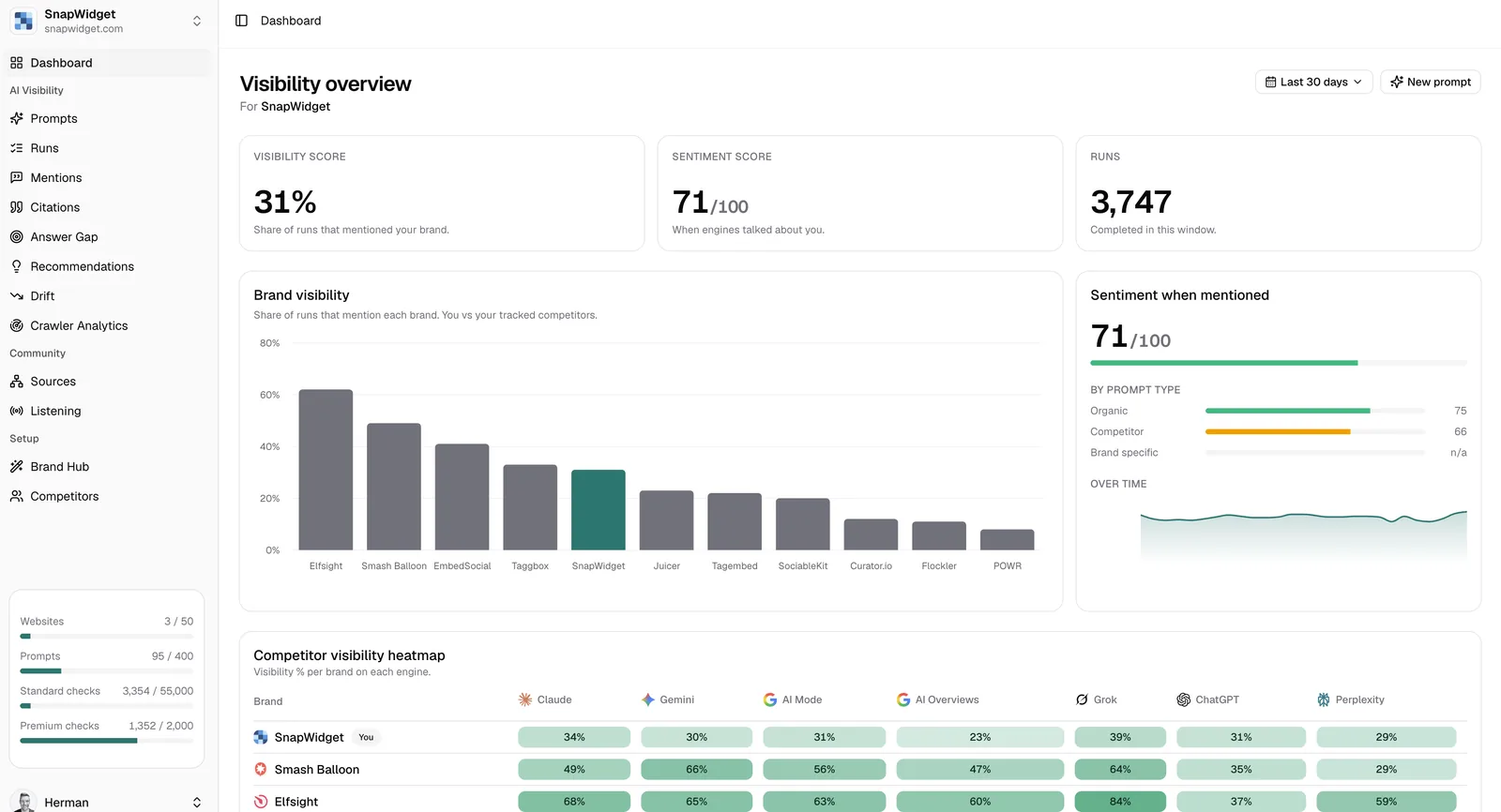
The dashboard for one of our own products, SnapWidget: visibility score, sentiment, share of AI answers per brand, and the per-engine heatmap, from 3,747 tracked answers in the last 30 days.
Where it goes further than most of this list: it also watches Reddit, Hacker News and Bluesky for the conversations AI engines cite, flags answer gaps where competitors appear and you do not, and reads your server logs to show which AI crawlers visit your pages and which visits turn into citations and clicks. The 1,507-answer sample this post opened with came straight out of it.
Pricing starts free with 10 tracked prompts, no card required. The $59/mo Starter plan tracks 40 prompts across five engines, and paid plans go up from there. There is also a free AI visibility checker that runs without a signup, if you want your current state before tracking anything.
2. Profound
Profound is the enterprise pick. It monitors 9+ engines, has server-side AI crawler analytics, large prompt-volume panel data, and the compliance checklist bigger companies ask for: client workspaces, SSO, SOC 2. Pricing starts at $99/mo and climbs steeply with volume. A free tier is not listed.
Pick it if you are an enterprise marketing team or an agency running AI visibility for large clients and the budget line already exists. For a small SaaS it is usually more machinery than the problem needs.
3. Peec AI
Peec AI is a Berlin-based tracker built for marketing teams and SEO agencies. Daily prompt tracking across 6 models, share of voice, citation analysis at domain and URL level, and unlimited team seats, which matters more than it sounds once an agency has five people in the tool.
Pricing starts at €89/mo. A free tier is not listed. The complaint we hear most from switchers is prompt limits on the cheaper plans, so check the math against your prompt list before committing.
4. Otterly.AI
Otterly.AI is one of the cheapest ways into prompt-based AI search monitoring: $29/mo, free tier to test. It covers 4 core engines with add-ons for more, and does competitor benchmarking and agency workspaces without much setup.
The trade-off is depth. Coverage beyond the core engines costs extra, and there is no community listening or crawler-side view. If you mainly need to prove to your team that the category matters, this is a cheap way to do it.
5. Semrush AI Toolkit
The Semrush AI Visibility Toolkit is an add-on to the biggest name in SEO software. It tracks ChatGPT and Google AI Mode, with prompt tracking, brand performance reports and sentiment, for $99/mo per domain with 25 prompts. No free tier.
If your team already lives in Semrush, having AI visibility next to rank tracking is genuinely convenient. Buying it standalone is a different calculation: $99 covers two engines and 25 prompts on one domain, the narrowest coverage-per-dollar on this list.
6. SE Ranking
SE Ranking bundles AI visibility into its SEO platform. The Core plan at $129/mo includes 100 tracked prompts daily across 5 LLMs (Google AI Overviews, AI Mode, ChatGPT, Gemini and Perplexity) plus AI source analysis, and an expanded AI Search add-on is $89/mo on top. There is a 14-day free trial.
Like Semrush, the value case is the suite. If you want rank tracking, audits and AI visibility on one invoice, the bundle is fair. As a pure AI visibility purchase, $129/mo buys the whole SEO platform whether you need it or not.
7. Surfaced
Surfaced tracks 13 AI models, the broadest engine list here, and rolls everything into a single composite AEO Score with daily scans. It starts at $29/mo and has a free tier.
The composite score is the point and also the limitation. One number is easy to report upward, but you will want to click through to the underlying answers to know what to fix. Teams that mainly need a trend line at a low price get exactly that.
8. LLMrefs
LLMrefs sells one flat plan: $79/mo for 9 engines with unlimited projects, domains and seats, and a 7-day trial. For agencies and portfolio operators tracking many small sites, that pricing shape beats every per-domain competitor on this list.
It is keyword-driven rather than conversation-driven, so it feels closest to a classic rank tracker pointed at AI engines. Fewer bells, predictable bill.
9. Promptwatch
Promptwatch covers 9+ models and pairs monitoring with content generation and on-site AI crawler analytics, starting at $95/mo with a free plan to try.
It is the only other tool on this list that touches both community signals and the crawler side. If you want monitoring plus AI-assisted content production in one place, it is the closest thing to a do-everything option. You pay for the breadth.
How to pick the right AI visibility tool
Map the decision to your situation rather than the feature grids:
- You want to spend under $100/mo: Otterly.AI or Surfaced at $29, MentionScout at $59, LLMrefs at $79. All four leave room to upgrade once the reports earn their keep.
- You are already paying for Semrush or SE Ranking: try the bundled toolkit first. If the prompt limits or two-engine coverage pinch, the standalone tools above cover more for less.
- You are an agency: Peec AI for seats, LLMrefs for unlimited domains, Profound when the client is enterprise-sized.
- You want the full loop, answers plus the communities AI cites plus crawler evidence: that combination is why we built MentionScout, and Promptwatch is the nearest neighbor.
Whatever you pick, start by writing down the 20 questions your buyers actually ask. Every tool on this list gets far more useful when the prompt list is real, and the cheap plans stop looking cheap when 25 prompts will not fit it.
Frequently asked questions
What is an AI visibility tool?
Software that tracks whether AI assistants like ChatGPT, Claude, Gemini and Perplexity mention or cite your brand when people ask questions in your category. It runs your target prompts on a schedule, records the answers, and turns them into visibility scores, competitor comparisons and source lists you can act on.
How much do AI visibility tools cost in 2026?
The self-serve tools run $29 to $129 per month depending on engines covered and prompt limits, with enterprise platforms like Profound priced above that. Several offer free tiers or trials, so you can see your baseline before paying anything.
Do I need one if I already use Semrush or Ahrefs?
Check what your suite actually covers first. The Semrush toolkit tracks two engines with 25 prompts for $99/mo; dedicated tools cover 6 to 13 engines at similar or lower prices. If AI answers are already sending you traffic, or your competitors keep appearing in them, the dedicated coverage usually pays for itself.
How do these tools measure visibility if AI answers change every time?
By sampling. Each tool runs prompts repeatedly across engines and reports how often you appear, so the score is a rate, not a yes or no. That is also why raw answer archives matter: when a score moves, you want to read the actual answers that moved it.