
On this page
When you start watching AI crawler traffic closely, one pattern shows up on almost every site, and it looks like a bug until you understand what it is: AI bots keep requesting URLs that have never existed.
Not broken links. Not old pages that moved. URLs that were never there. That is what I mean by a hallucinated URL: a page an AI assistant requests or cites that has never existed on your site. A pure guess. On one of our own sites, AI bots requested a path called /null 66 times. The first time I saw it stacking up in the logs I assumed our own tracking was broken. They asked for /contact 5 times. That site has never had a /contact page. They also requested a path shaped exactly like a search query, the kind of URL you would only guess if someone had just asked you a very specific question about that product.
Every one of those requests got a 404. And most of them happened while an assistant was mid-answer, trying to tell someone something about us.
Why AI assistants invent URLs
Language models complete patterns. Most SaaS sites have a /pricing page, a /demo page, a /contact page. So when someone asks an assistant "how do I book a demo of this product", the assistant does something very human: it guesses. It fetches yourdomain.com/demo, because that URL exists on ten thousand other sites, so it probably exists on yours.
Sometimes the guess happens before a search. Sometimes it happens instead of one. Live answer fetchers like ChatGPT-User will happily request a guessed URL directly, in real time, while a user waits for the answer. We covered how fast those fetches happen in the crawl-speed experiment: minutes, not days. The same machinery that reads your real pages within minutes of publishing is also probing the pages it assumes you have.
The guesses are not random noise. They cluster hard around a handful of paths, and each one tells you what the assistant was trying to find:
/demo means someone asked to see the product in action. /free-trial means someone asked what it costs to try. /docs/api means a developer asked whether you have an API. And the keyword-shaped ones are the most interesting of all: a bot requesting /product-analytics-software is a bot that just got asked about product analytics software and went looking for your page on it.
This is what that traffic looks like when you split it out:
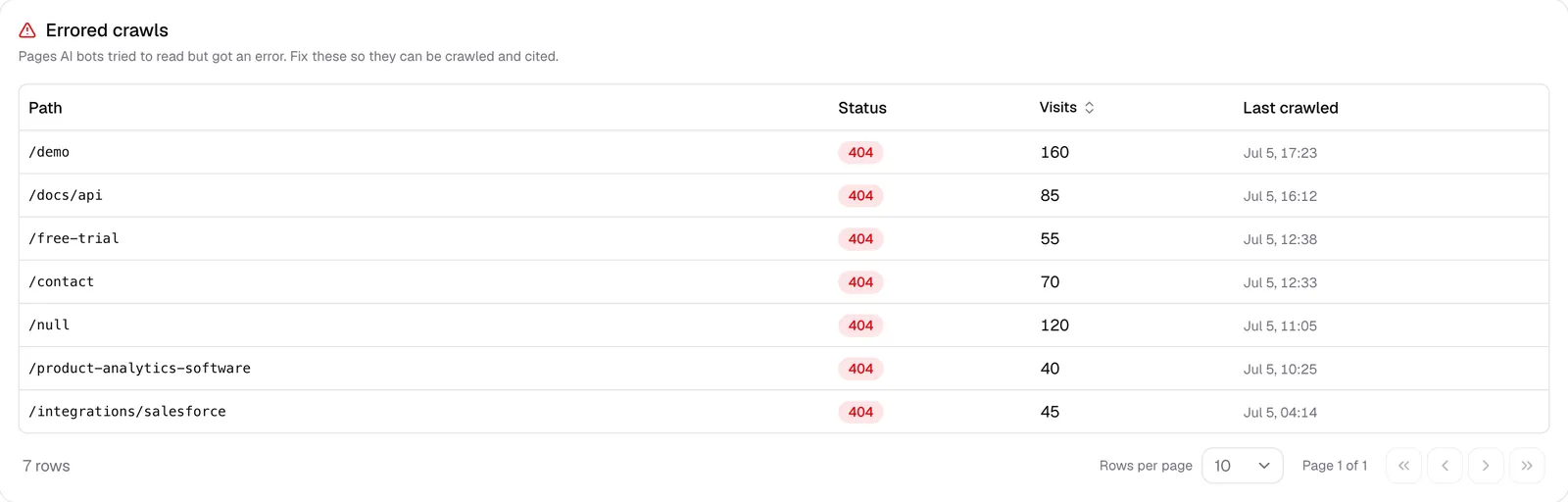
What it looks like in MentionScout when AI bots request pages that don't exist: seven paths, all 404, hundreds of requests. On this dashboard the most-requested page on the entire site was one that had never been built.
Hallucinated URLs are demand data
Once I understood what these requests were, I stopped reading our 404 log as an error report. Every hallucinated URL is a question someone asked an AI about you, answered with a guess, and lost.
A user asked for a demo. The assistant guessed /demo, got a 404, and either gave up or sent them somewhere else. That is a warm lead bouncing off a page you never built. Multiply it by every live-answer fetch in your logs and you are looking at a list of things people actively want from your site, compiled for free, by the assistants themselves.
There is a well-known precedent for this. Adrian Holovaty, the founder of Soundslice, noticed error logs full of ASCII guitar tabs that users were uploading because ChatGPT kept telling them Soundslice could import the format. It could not. ChatGPT had invented the feature. Rather than fight the misinformation, he built the feature, and the demand ChatGPT had manufactured was already waiting for it.
Hallucinated URLs are the same mechanic one level down. The AI has already decided what your site should have. You can keep 404ing the requests, or you can ship the page and collect.
What happened when the pages went live
The fix is embarrassingly cheap. For each hallucinated path, you either create the page or 301 it to the closest real one. A /demo path can redirect to your existing demo booking page. A guessed docs path can redirect into the real docs. The keyword-shaped paths usually deserve an actual page, because they are telling you exactly which query they came from.
Once the pages exist, the loop closes fast. The bots that were guessing the URL keep requesting it, except now they get content instead of a 404. The live-answer fetchers can quote it. And the referral clicks start showing up:
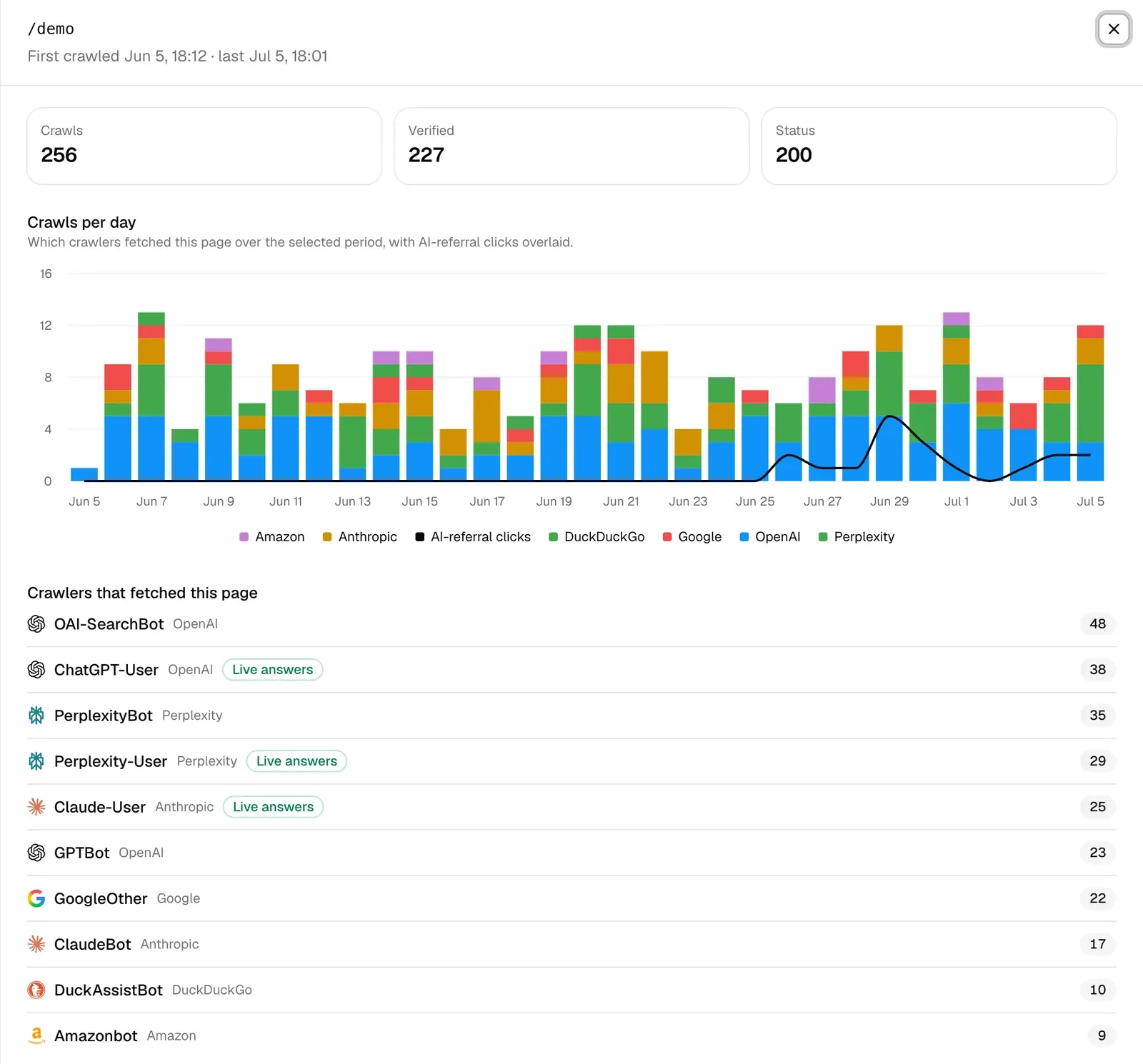
The same guessed path after shipping a real page: crawls keep coming (256 in this window, 227 verified), the status flips to 200, and the black line is AI-referral clicks that simply did not exist before.
The demand was there the whole time. The only thing that changed is that it stopped landing on nothing.
How to find hallucinated AI URLs in your server logs
You can do this with server logs and an afternoon:
- Filter your access logs to AI crawler user agents. We keep a reference list of every AI crawler, grouped by what each bot does, so you know what to grep for.
- Keep only the requests that returned 404, and group them by path.
- Sort by count. Anything requested more than a handful of times by live-answer or search-index bots is a page the AI ecosystem already believes you have.
- Ship the page or 301 the path. Prioritize the keyword-shaped ones; they map directly to questions people are asking.
One warning from doing this myself: do not dismiss the weird ones too quickly. /null looks like garbage, and mostly it is, an artifact of agents mishandling empty values. But the rest of the list is usually uncomfortably sensible. Ours read like a roadmap review written by someone who had never seen the site but knew exactly what customers ask for.
If you would rather not grep logs, this is one of the things MentionScout's crawler analytics does out of the box: every AI bot hit on your site, verified, split by purpose, with errored crawls surfaced on their own card so the hallucinated URLs are impossible to miss.
Worth checking the basics while you are at it: the free AI visibility checker shows whether ChatGPT, Perplexity and Google AI know your brand at all, and whether your pages are readable to their crawlers. Takes two minutes, no signup.
Your 404 log has been collecting this data the whole time. The assistants are telling you what they expect your site to have, dozens of times a day, one guessed URL at a time. It is the cheapest product research you will ever get, and until you look, you are answering it with an error page.