

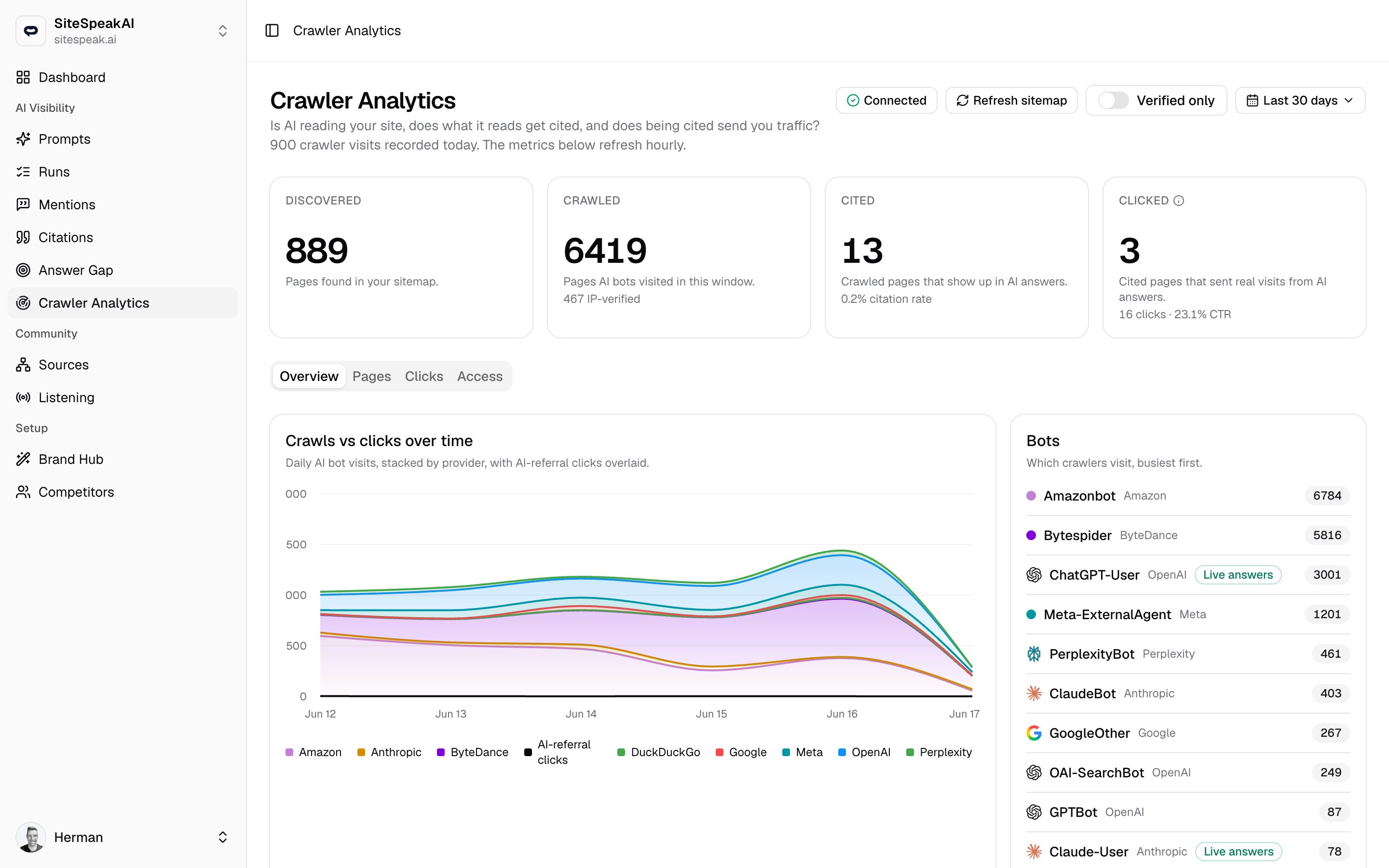
The funnel
The four cards across the top are the heart of the page. Each stage feeds the next, so reading them left to right tells you exactly where AI visibility is breaking down.Crawled
Pages AI bots actually visited in the selected window. The subtext shows how many of those visits were IP-verified, meaning the request came from an IP that belongs to the provider it claimed to be.
Cited
Crawled pages that then showed up in AI answers. The subtext shows the share of answer-engine crawls that get cited, for example
40% of answer-engine crawls cited. Until there is something to measure it instead reads Needs crawled pages first (no crawled pages yet) or No answer-engine crawls yet (pages crawled, but only by index or training bots that never produce answers).The number on the Clicked card counts cited pages that received an AI-referral click. Your total click volume, including pages outside the cited sample, is the count in the subtext and everything on the Clicks tab.
Connecting your site
AI bots do not run JavaScript, so crawler tracking runs at the edge of your domain rather than as a page tag. The button in the top right reflects your connection state:- Connect your site when no tracking is set up yet.
- Awaiting visits once tracking is in place but no visit has arrived.
- Connected once the first visits are flowing in.
Set up crawler tracking
Generate an ingest token, deploy the edge worker on your domain, and confirm visits are arriving.
Controls
The toolbar above the funnel adjusts what every number on the page reflects.| Control | What it does |
|---|---|
| Refresh sitemap | Re-reads your sitemap to pick up new or removed pages, which updates the Discovered count. |
| Verified only | Restricts every metric to IP-verified visits, so unverifiable bots drop out of the chart, the bot list, and the page tables. |
| Last N days | Sets the time window to 7, 30, or 90 days. The default is 30. |
Overview tab
The default tab pairs a trend chart with a ranked list of who is visiting.- Crawls vs clicks over time plots daily AI bot visits, stacked by provider, with AI-referral clicks overlaid as a single line. It is the quickest way to see whether crawling and click traffic are rising or falling together.
- Bots ranks the crawlers hitting your site, busiest first. Each row shows the bot name (such as
Amazonbot,ChatGPT-User,PerplexityBot,ClaudeBot, orGPTBot) and the provider behind it.
A Live answers badge on a bot means it fetched a page live to answer a user, rather than to train or build a search index. That is a strong signal your page is being used in an answer right then.
Pages tab
This tab is page-level detail on what AI reads and what it does with it. The main Pages table lists every path AI bots visited, most visited first. You can filter it by typing a path into the search box.| Column | What it shows |
|---|---|
| Path | The page that was crawled. |
| Visits | Total AI bot visits to that path in the window. |
| Verified | How many of those visits were IP-verified. A green check means every visit to the page came from a verified provider IP. |
| Last crawled | When a bot last read the page, or never. |
| Status | The last HTTP status returned. A 4xx or 5xx shows in red. |
Errored crawls
Errored crawls
Pages AI bots tried to read but got an error, with the status code and how many times it happened. Fix these so the pages can be crawled and cited. This card only appears when there are errors to show.
Crawled but never cited
Crawled but never cited
Pages AI reads but never cites. High-traffic paths here are content that AI sees yet does not credit, which is where on-page improvements can pay off.
Cited but stale
Cited but stale
Pages AI cites but has not crawled recently, stalest first. If the cited content has changed, AI may be answering from an old version until it crawls again.
Clicks tab
When an AI answer links to one of your pages and someone follows that link, it counts as an AI-referral click. This tab breaks those clicks down three ways.- Top clicked pages shows which of your pages AI answers send people to. Each path links out to the live page.
- Top AI referrers shows which AI assistants send you the most clicks, by referring host and provider.
- Top click countries shows where your AI-referral visitors come from.
Access tab
The robots.txt audit checks which AI crawlers yourrobots.txt currently lets in. Each row pairs a crawler and its provider with a verdict:
| Verdict | Meaning |
|---|---|
| Allowed | The crawler is free to read your site. |
| Partial | The crawler is allowed on some paths and blocked on others. |
| Blocked | Your robots.txt blocks this crawler entirely. |
| unknown | No clear rule was found for it. |
robots.txt, for example after you change the file.
Related
Set up crawler tracking
The one-time install that powers this dashboard.
Citations
The Cited stage connects here: see exactly which AI answers credit your domain as a source.