

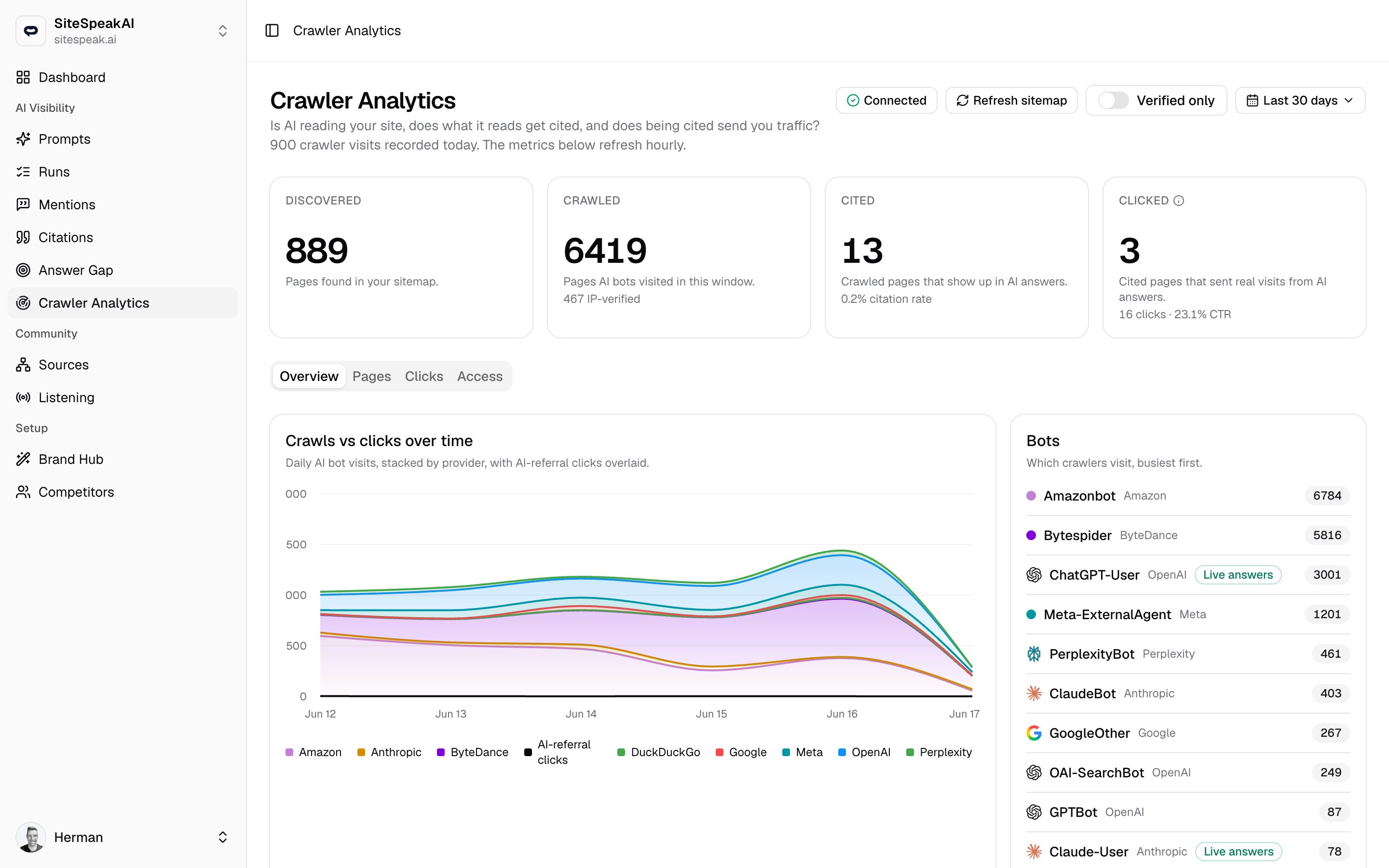
Tracking runs as a Cloudflare Worker, so your domain needs to be on Cloudflare with proxied DNS (the orange cloud). Select the website you want to track before you start. The Connect your site button only appears once a website is selected.
How it works
The worker sits in front of your site and watches each request after the page is already served, so it never slows visitors down. It reports two kinds of event:- Crawls - a request whose user agent matches a known AI bot. The worker records the path, the response status, the user agent, and the visitor IP so the bot can be IP-verified.
- Clicks - a normal visitor who arrived from a known AI assistant. The worker records the path, the response status, and the referring host only. There is no visitor IP, and the country comes from Cloudflare’s free
CF-IPCountryheader.
/api/crawler-events, authorized with your ingest token as a Bearer credential. Both the endpoint and the token are written into the generated worker script, so there is nothing to wire up by hand.
Connect your site
Open the connection dialog
Go to Crawler Analytics and click Connect your site in the top-right corner.
Generate an ingest token
Click Generate ingest token. MentionScout issues one ingest token for this website and uses it to build your worker script, with the token baked in. Generating the token also reads your sitemap to seed the Discovered baseline and warms the bot IP-range list so your first visits can verify straight away.
Copy the worker script
Click Copy worker script. This copies the full worker, with your ingest endpoint and token already filled in.
Create the worker in Cloudflare
In the Cloudflare sidebar, open Compute -> Workers & Pages, then click Create application. On the “Create a Worker” screen, choose Start with Hello World! and create the worker.
Paste the script and deploy
Open Edit code, replace everything in the editor with the script you copied, then click Deploy.
Add a route for your domain
Open your domain in Cloudflare, go to Workers Routes, and click Add route. Set the route to
yourdomain.com/* and select this worker.The worker runs at Cloudflare’s edge and adds well under a millisecond. It runs on all traffic to your domain, which counts toward Cloudflare’s Workers usage. Their free plan covers 100,000 requests per day.
Verified visits
A crawl is Verified when the request came from an IP address that belongs to the provider it claims to be. Because the worker sends the visitor IP on every crawl, MentionScout can check it against published bot IP ranges and confirm the bot is genuine rather than a spoofed user agent.- The Crawled funnel card shows how many of the crawled pages were IP-verified.
- The Pages table has a Verified column, with a check mark on pages where every visit came from a verified provider IP.
- The Verified only toggle in the toolbar filters the whole dashboard down to verified visits, dropping bots that can never verify.
Refresh the discovered baseline
The Discovered stage of the funnel is the set of pages MentionScout found in your sitemap. Click Refresh sitemap in the toolbar to re-read your sitemap and pick up new or removed pages. Do this after you publish a batch of new content so the crawl and citation rates compare against an up-to-date page count.Access tab
The Access tab audits yourrobots.txt and shows which AI crawlers it lets in. This is the gate before crawling: a bot that your robots.txt blocks can never read a page, so it can never cite it.
Each row lists a crawler, its provider, and a verdict:
| Verdict | Meaning |
|---|---|
| Allowed | Your robots.txt lets this crawler read your site. |
| Partial | The crawler is allowed on some paths and blocked on others. |
| Blocked | Your robots.txt disallows this crawler entirely. |
| unknown | No clear rule was found for this crawler. |
robots.txt again and re-run the audit, for example after you change which bots you allow. If you want AI answers to cite you, make sure the crawlers you care about are not Blocked.
Manage or rotate the token
Once you are connected, open the Connected button again to manage the token:- Regenerate token issues a fresh token and worker script. The old token stops working, so paste the new script into your worker and redeploy it. Use this to rotate the token, or to move tracking to another domain.
- Revoke deletes the token. The worker stops reporting until you generate a new one and redeploy.
Running a high-traffic site
The worker runs on every request to your domain. On busy sites you can stop it running on non-content paths (assets, embeds, APIs) using Cloudflare “no-script routes”: add a more specific route with No worker assigned, and keep the broadyourdomain.com/* route on this worker. The more specific route wins, so those paths skip the worker entirely.
/cdn-cgi/*, /wp-json/*, and /wp-admin/*. The connection dialog also lists Suggested for your site: the non-content paths it actually sees AI bots hitting, so you can scope the worker with confidence.
Next step
Once events are flowing, head back to the dashboard to read the funnel, the per-page breakdown, and your AI-referral clicks.Crawler Analytics
Read the crawl, cite, and click funnel, see which bots visit, and find pages that are crawled but never cited.